Love to hear from you!
Get in touch.

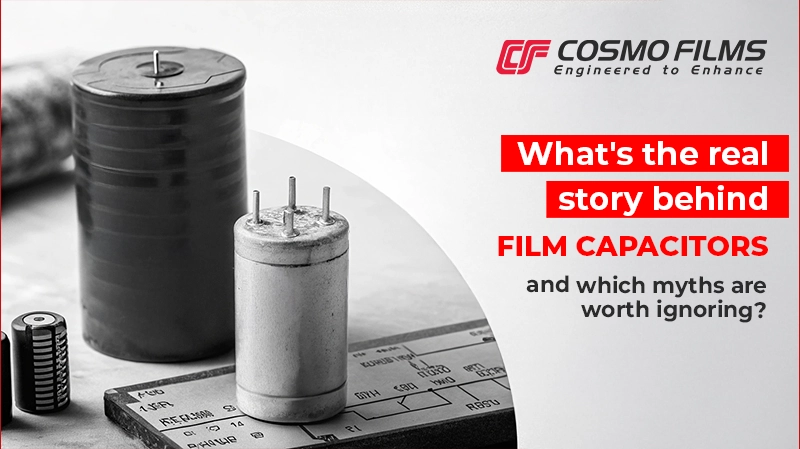
Many misconceptions about film capacitors persist, especially
around reliability, cost, and performance. The truth: film capacitor types,
especially those built with capacitor polypropylene film, offer some of
the most stable, long-life performance in the entire capacitor family.
Most myths arise from outdated information or a misunderstanding
of modern materials.
Myth 1
Film capacitors are too expensive
This myth persists because early generations of capacitor films
were indeed costlier than alternatives like electrolytic capacitors. But modern
production techniques and automated winding have dramatically lowered
manufacturing costs.
More importantly, cost must be evaluated over the component's
lifetime. Film capacitors’ offer:
When you factor in replacement cycles, downtime, and service
costs, film capacitors often become more affordable than supposedly cheaper
options.
Myth 2
Polypropylene film capacitors are fragile and easily damaged
Wrong. Earlier polypropylene capacitor designs were
susceptible to moisture ingress and thermal stress. Today, improved
metallization patterns, optimized winding tension, and advanced encapsulation
techniques make the modern capacitor polypropylene film tough, resilient, and
reliable.
Modern polypropylene film capacitors are known for:
This makes them ideal for demanding environments, including
renewable energy, industrial drives, and automotive power electronics.
Myth 3
Film capacitors can't handle high-frequency circuits
This misconception stems from confusing film capacitors with bulky
legacy designs. While some film capacitor types are not ideal for
extreme RF applications, many modern variants are specifically engineered for
high-frequency use.
Polypropylene films, in particular, exhibits:
This makes them suitable for:
Myth 4
All film capacitors are the same
Definitely not! "Film capacitor" is a broad category,
and each dielectric material brings its own characteristics and trade-offs.
Common film capacitor types include:
Even within polypropylene-based capacitors, metallization style,
film thickness, and winding techniques result in significant performance
differences.
Myth 5
Film capacitors have poor longevity compared to electrolytics
This one flips the truth on its head. Electrolytics often suffer
from electrolyte evaporation, which shortens their lifespan. Film capacitors,
especially those using capacitor polypropylene film, contain no liquid
electrolyte.
Benefits include:
It's common for film capacitors in industrial systems to outlast
entire pieces of equipment.
Myth 6
Only small manufacturers produce film capacitors, so quality
varies widely
The major global film capacitor manufacturer ecosystem is
highly standardized. Many operate under strict automotive, aerospace, or
industrial certification frameworks.
Myth 7
Film capacitors can't handle high ripple current
Modern polypropylene film capacitors are excellent at handling
high ripple current thanks to their low ESR and efficient heat dissipation.
Metallized PP structures spread current evenly across the electrode surface,
minimizing hotspots.
These environments demand durability under thermal and electrical
stress, an area where film capacitors routinely outperform electrolytics.
Myth 8
Film capacitors aren't suitable for pulse or surge applications
A common misunderstanding confuses film capacitors with small
signal caps. In truth, many film types, especially polypropylene, are
engineered for high dV/dt, fast pulse discharge, and surge handling.
Self-healing metallized films allow the capacitor to clear micro-faults
instantly without catastrophic failure.
Want help choosing the right film capacitor types for your
application? Connect with us, a leading film capacitor manufacturer, for
high-quality capacitor films.
Featured Post
Love to hear from you!
Get in touch.