Love to hear from you!
Get in touch.

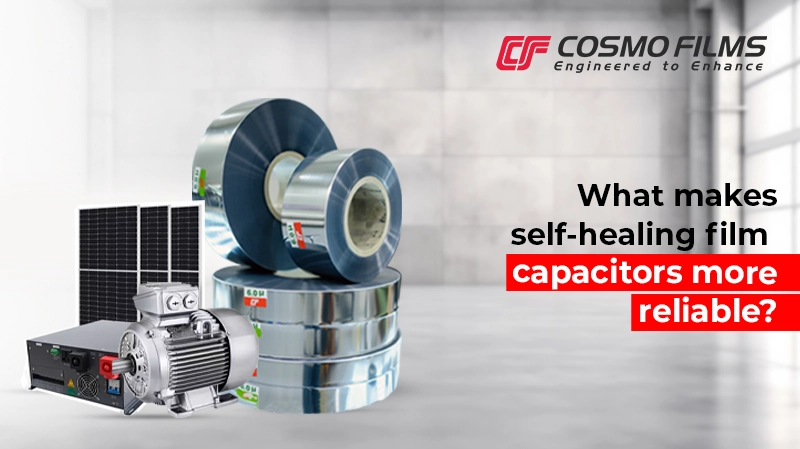
In capacitor films, self-healing refers to the ability
of the capacitor to isolate and repair internal dielectric breakdowns
automatically, allowing it to continue operating safely instead of failing
catastrophically. This property significantly improves reliability, lifespan,
and safety in electronic systems.
In this blog, we will understand that.
·
Self-healing occurs when a localized dielectric
fault vaporizes the surrounding electrode material
·
The fault is isolated without destroying the
capacitor
·
This prevents short circuits, fires, and sudden
system failures
·
Self-healing is critical in applications like
power electronics, EVs, renewable energy, and industrial systems
Polypropylene capacitors use a thin plastic film as the
dielectric material, with metal electrodes layered on or embedded within the
film. They are widely used for:
·
DC link circuits
·
EMI suppression
·
Signal coupling and decoupling
·
Power factor correction
Compared to electrolytic capacitors, film capacitors are known
for stability, low loss, and long service life. One of the biggest reasons for
that reputation is self-healing.
What exactly is self-healing?
Self-healing is a controlled, microscopic recovery process
that occurs when an internal electrical fault develops. Faults typically
originate from:
·
Manufacturing imperfections
·
Mechanical stress
·
Voltage spikes or transients
·
Aging of the dielectric film
When the electric field becomes too strong at a weak point,
the dielectric can break down locally.
What happens next? Instead of forming a permanent short
circuit:
·
A small arc occurs at the fault location
·
The intense heat vaporizes the thin metal
electrode around the defect
·
The damaged area becomes electrically isolated
·
Normal operation resumes almost instantly
Why is self-healing important?
1. Prevents catastrophic failure - Without
self-healing, a dielectric breakdown would cause:
·
A permanent short circuit
·
Rapid overheating
·
Potential fire or explosion
Self-healing capacitor films typically fail open
circuits, which is far safer than short-circuit failure modes.
2. Extends capacitor lifespan - Each self-healing event
slightly reduces electrode area, but modern film capacitors are designed to
tolerate thousands of such events. This translates to:
·
Longer operational life
·
Stable performance over time
·
Reduced need for replacement
In long-life applications such as solar inverters and wind
turbines, this is critical.
3. Improves system reliability - In systems where downtime is
costly - industrial drives, medical equipment, EV powertrains - self-healing
ensures that minor internal defects don’t bring down the entire system. Engineers
can design with:
·
Lower maintenance expectations
·
Higher confidence in long-term operation
·
Better compliance with safety standards
4. Enhances safety in high-energy applications - Polypropylene
capacitors are often used in high-voltage, high-energy environments.
Self-healing helps:
·
Limit fault energy
·
Avoid cascading failures
·
Protect surrounding components
This is especially important in:
·
DC-link capacitors
·
Power factor correction banks
·
Grid-connected power electronics
Where is self-healing most important?
You’ll find self-healing capacitor films in:
·
Electric vehicles (DC link capacitors)
·
Solar and wind inverters
·
Industrial motor drives
·
Power supplies and UPS systems
·
Consumer electronics require long-term
reliability
In these environments, graceful degradation is far better than
sudden failure.
Conclusion
Self-healing is not just a technical feature; it’s a core
reliability mechanism that makes polypropylene capacitors safe, durable,
and trusted across modern electronics. By automatically isolating internal
faults, self-healing:
·
Prevents catastrophic failure
·
Extends service life
·
Improve safety
·
Reduces maintenance costs
For engineers and system designers, understanding self-healing
is essential to choosing the right capacitor and building systems that last.
Featured Post
Love to hear from you!
Get in touch.