Love to hear from you!
Get in touch.

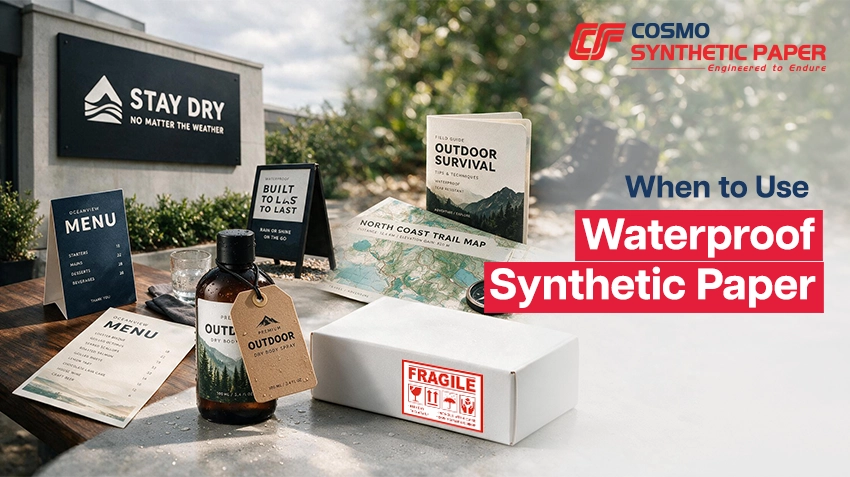
Printed promotional materials often face far more demanding
conditions than they did in the past. Whether its outdoor signage exposed to
rain, restaurant menus that endure constant handling, or product labels that
need to withstand moisture and oils. That's where waterproof synthetic paper
comes in. Offering the familiar look and feel of paper with the durability of
plastic, synthetic paper delivers outstanding performance.
Synthetic paper’s unique combination of durability and
printability makes it an ideal choice for a wide range of industrial,
commercial, and promotional applications. Let’s take a look at some of them:
1. Outdoor Signage and Promotional Displays
Outdoor printed materials are constantly exposed to changing
weather conditions, including rain, humidity, sunlight, and temperature
fluctuations. Its durability helps maintain both appearance and readability for
extended periods, even in demanding outdoor environments.
Cosmo Synthetic Paper is an excellent solution for:
2. Restaurant Menus and Hospitality Materials
Menus in restaurants, cafés, and hotels are frequently handled
and often exposed to spills, stains, and moisture.
Using synthetic paper provides several advantages, like:
3. Product Labels and Tags
Labels made for outdoor use must remain readable throughout a
product's lifecycle, regardless of handling conditions.
Synthetic paper is widely used for the following outdoor uses:
4. Maps, Manuals, and Instruction Guides
Documents used in outdoor, industrial, or field environments
require greater durability than standard paper can offer. Its tear-resistant
and moisture-resistant properties help preserve important information, even
after repeated use. Our waterproof paper is ideal for:
5. Packaging Inserts and Information Sheets
Product inserts and information sheets may encounter moisture
during storage, transportation, or end use. This makes it an excellent choice
for premium packaging solutions where durability and appearance are equally
important. Synthetic paper helps by providing:
To Conclude,
With synthetic paper’s excellent water resistance, businesses
create printed materials that continue to perform and look professional for
longer. We, the best synthetic paper manufacturer, offer waterproof paper
engineered for demanding printing applications where durability and moisture
resistance are critical. Visit www.cosmofilms.com/category/synthetic-paper
to know more.
Frequently Asked Questions
1. What makes synthetic paper waterproof?
A. Synthetic paper is manufactured from polypropylene film that
do not absorb water like conventional paper, allowing it to resist moisture,
spills, and humidity.
2. Is synthetic paper
suitable for restaurant menus?
A. Yes, it resists spills,
stains, and frequent handling, making it ideal for reusable menus.
3. What types of tags
and labels can be printed on waterproof paper?
A. Synthetic paper is
commonly used for plant tags, nursery tags, shipping tags, asset tags,
logistics tags, and industrial labels.
4. Can waterproof synthetic paper be used for maps
and instruction manuals?
A. Yes, it is ideal for documents that need to remain readable in outdoor,
industrial, or high-use environments.
5. What factors should you consider when choosing
waterproof synthetic paper?
A. Consider the application, printing method, required
durability, thickness, and environmental exposure before choosing synthetic
paper.
Featured Post
Love to hear from you!
Get in touch.