Love to hear from you!
Get in touch.

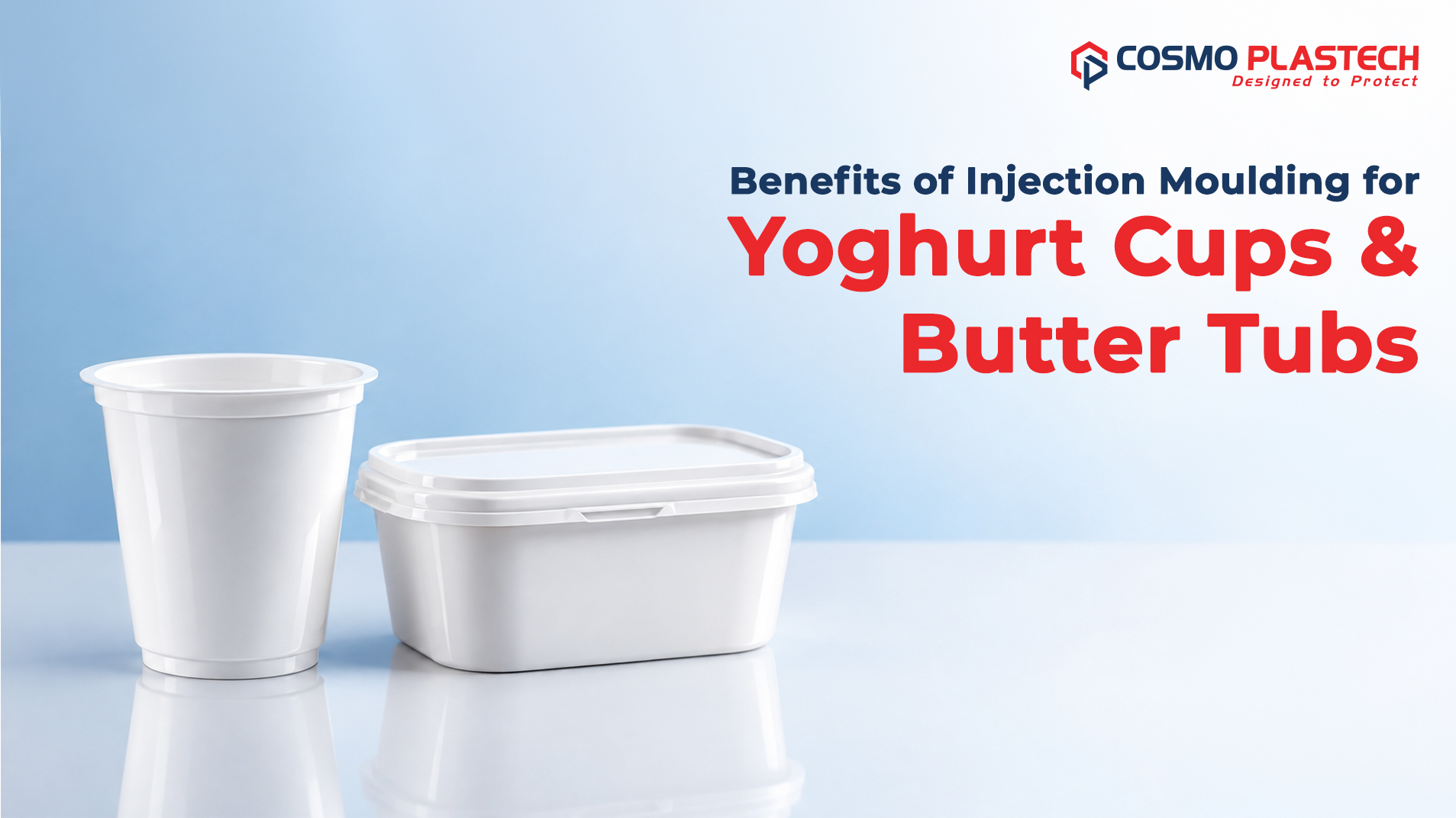
Rigid packaging needs to balance strength, precision, functionality, appearance, and production efficiency, be it yogurt cups, butter tubs or food storage containers. For manufacturers producing packaging at scale, injection moulding offers a practical way to achieve these requirements consistently.
The injection moulding process has the ability to produce complex shapes with tight dimensional control, smooth surfaces, and repeatable quality, making injection moulding containers suitable for everyday food packaging applications.
Why Injection Moulding Is Suitable for Food Packaging
Food packaging often needs to perform across multiple stages, and injection moulding supports this by producing containers with consistent dimensions and structural integrity. For high-volume applications, the process also enables manufacturers to produce large quantities of identical containers while maintaining repeatability.
Key advantages include:
Injection Moulded Containers for Yogurt Cups
Yogurt cups must be lightweight while offering enough rigidity to withstand filling, stacking, transportation, and retail handling. Injection moulding can produce cups with controlled wall thickness and consistent dimensions, helping maintain their shape throughout these stages.
The process also allows manufacturers to create packaging in different shapes and sizes to suit product volumes and brand requirements. For large dairy manufacturers, high-volume repeatability is another important advantage. Injection moulding can produce large numbers of identical cups while maintaining consistency between production cycles.
Injection Moulded Containers Butter Tubs
Butter and margarine tubs require more than basic containment. Their design often incorporates features that improve opening, closing, handling, stacking, and storage. Injection moulding is well suited to producing these features with precision. Containers and their corresponding lids can be manufactured with accurate dimensions to support reliable fitting.
Some of the features injection moulding can support include:
Why Design Flexibility Matters
One of the biggest advantages of injection moulding is the ability to incorporate functional details directly into the container design.
Instead of treating packaging as a simple vessel, manufacturers can design it around the way the product will be filled, transported, stored, opened, closed, stacked, and used.
This makes injection moulding suitable for packaging that requires:
For yoghurt and butter containers, manufacturers often need to produce thousands or millions of units with consistent quality. Injection moulding is designed for this kind of repeatable production. Its ability to combine high-volume manufacturing, precision, automation, and design flexibility makes it an important technology for modern rigid food packaging.
As food brands continue to seek packaging that is functional, visually appealing, lightweight, and efficient to manufacture, injection moulding remains a strong choice for applications ranging from dairy cups to reusable food storage solutions.
Frequently Asked Questions
1. Is injection moulding suitable for yogurt cups?
Yes, it enables high-volume production of lightweight cups with consistent dimensions and structural stability.
2. Are butter tubs commonly injection moulded?
Yes. The injection moulding process allows precise container and lid designs with features such as snap fits, rims, and grooves.
3. Can injection moulding be used for food storage containers?
Yes, it can produce containers in different sizes and shapes with features such as lids, handles, ribs, and stackability.
4. What makes injection moulding suitable for high-volume food packaging?
Its repeatability, automation potential, and fast production cycles support large-scale manufacturing.
5. What determines the quality of an injection-moulded food container?
Material selection, mould design, wall thickness, cooling, and processing conditions all contribute to container quality.
Featured Post
Love to hear from you!
Get in touch.