Love to hear from you!
Get in touch.

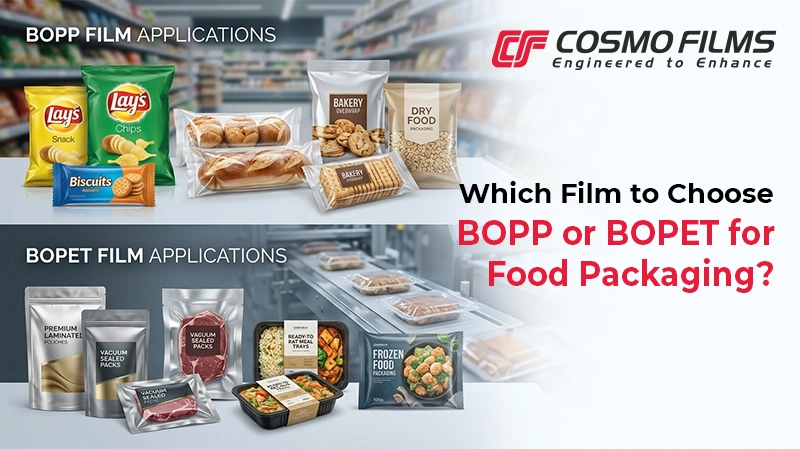
As packaging isn’t just a protection anymore, it’s a responsibility. Choosing the right packaging material is crucial for the food industry. Cosmo Films is dedicated to being your innovative, cost-efficient, & green packaging partner. Two commonly used materials are BOPP & BOPET, but many businesses and consumers are unsure which one is better.
What Is & Why To Use BOPP?
Biaxially Oriented Polypropylene Films (BOPP) are flexible
films widely used in packaging, labelling and lamination of basically snacks, as
they:
·
Provide excellent sealability, which acts as moisture resistance
·
Increase clarity, quality, and shelf appeal of the product
·
Ensure standing out by using low-density plastic, which provides
sustainability
·
Elevates product aesthetics
What Is & Why To Use BOPET?
Biaxially
Oriented Polyethylene Terephthalate (BOPET) is an advanced polyester
film in transparent and metallized variants that has become essential in
various industries and is valued for:
·
Remarkable strength, transparency and resistance to high
temperatures
·
Renowned for robust tensile strength and chemical stability
·
Unique combination of clarity, durability and thermal resilience
DIFFERENCE
|
Factor |
BOPP (Polypropylene) |
BOPET (Polyester) |
|
Material
Type |
Polypropylene-based
film |
Polyester-based
film |
|
Strength |
Moderate
strength |
Very
high strength |
|
Heat
Resistance |
Low–moderate |
High
(can handle heat processing) |
|
Moisture
Barrier |
Excellent |
Good |
|
Clarity
& Gloss |
Very
high (great for display) |
High
but slightly less glossy |
|
Sealability |
Excellent
(easy sealing) |
Needs
coating for sealing |
|
Flexibility |
More
flexible |
More
rigid |
|
Sustainability |
Lightweight
(less plastic usage) |
Durable
but heavier |
Which Is Better for Food Packaging?
Choosing
between BOPP & BOPET is not about selecting one material as a better one. The
choice between BOPP and BOPET goes beyond basic functionality and
largely depends upon packaging requirements.
Packaging Requirements:
Selecting
the right packaging material requires technical knowledge and industry
experience. Cosmo Films acts as your packaging partner to identify the most
suitable solution for getting full potential performance while being cost-efficient.
It provides solutions based upon:
·
Product type: BOPP is widely used for snacks, biscuits and
confectionery as it is more economical and flexible, whereas BOPET is
widely used in coffee, tea, premium dry foods and frozen foods because of its
stiffness, strength, chemical stability and temperature resistance
In
the packaging industry, the choice between BOPP and BOPET is a strategic
decision that balances cost, performance, and brand value, making it essential
for businesses to evaluate their specific needs before selecting the right
material.
Conclusion
In
flexible packaging, BOPP and BOPET films stand out as versatile and
reliable materials. Understanding the unique properties and applications of
each film type allows manufacturers to make informed decisions, ensuring the
optimal performance and cost-effectiveness of their packaging solutions.
Whether it’s the clarity and moisture resistance of BOPP or the strength and
chemical resistance of BOPET, these films play a crucial role in meeting the
diverse needs of the packaging industry.
Understanding
the differences between BOPP and BOPET films is crucial in making an
informed decision for your packaging needs. Each film offers unique properties
and serves different purposes, making the choice highly dependent on the
product’s specific requirements and the manufacturer’s goals.
By
selecting the right film, you can enhance your product’s shelf life, appeal,
and sustainability, ultimately contributing to greater customer satisfaction
and environmental responsibility. Rech out to us for more information.
Frequently Asked Questions: BOPP vs. BOPET Films
1. What is BOPP film?
BOPP
(Biaxially Oriented Polypropylene) is a lightweight, flexible film widely used
in flexible packaging, labelling and lamination. It offers excellent moisture
resistance, clarity, gloss and sealability.
2. What is BOPET film?
BOPET
(Biaxially Oriented Polyethylene Terephthalate) is a polyester film known for
its high tensile strength, clarity, dimensional stability, chemical resistance
and excellent heat resistance.
3. What is the main difference between BOPP and BOPET?
The
key difference lies in their performance characteristics. BOPP offers excellent
moisture resistance, flexibility, sealability and cost efficiency, while BOPET
provides higher strength, rigidity, chemical resistance and heat resistance.
4. Is BOPP or BOPET better for food packaging?
Neither
material is universally better. The right choice depends on factors such as the
product, packaging structure, required barrier properties, processing
conditions, storage environment and cost considerations.
5. Which is more suitable for snacks and biscuits?
BOPP
is widely used for snacks, biscuits and confectionery because of its excellent
moisture resistance, flexibility, printability, aesthetics and cost efficiency.
6. When should BOPET be used in food packaging?
BOPET
is suitable for applications requiring higher strength, stiffness, dimensional
stability and temperature resistance. It is commonly used in packaging
structures for products such as coffee, tea, premium dry foods and frozen
foods.
7. Does BOPP provide better moisture resistance than BOPET?
Yes.
BOPP generally provides excellent moisture barrier properties, making it
particularly suitable for applications where protection from moisture is
important.
8. Which film has better heat resistance: BOPP or BOPET?
BOPET
generally offers higher heat resistance than BOPP and is better suited for
applications involving elevated temperatures or demanding heat-processing
conditions.
9. Which film is more flexible, BOPP or BOPET?
BOPP
is generally more flexible, while BOPET offers greater rigidity and dimensional
stability.
10. Which film provides better clarity and gloss?
BOPP
is known for its high clarity and gloss, making it an attractive option for
packaging where shelf appeal and product visibility are important.
Featured Post
Love to hear from you!
Get in touch.