Love to hear from you!
Get in touch.

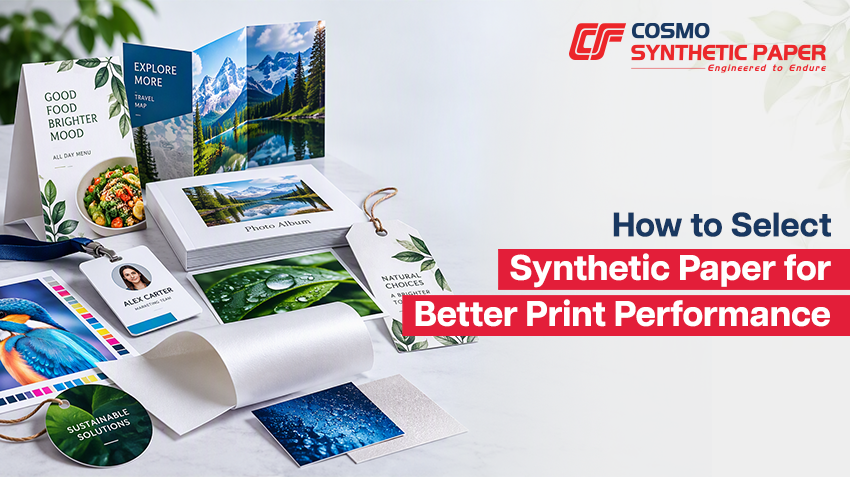
Selecting the right
synthetic paper is essential for ensuring label performance, print quality and
durability across different applications. From product labels and retail
packaging to outdoor signage and promotional materials, the choice of substrate
can influence how well the final product performs under actual usage
conditions.
Before selecting synthetic paper for your business, consider these five factors to identify a suitable option for your printing and application requirements.
Identify where and how the printed material will be used. Labels for food and beverage packaging, personal care products, industrial goods and logistics applications may face different handling and environmental conditions. Consider whether the application involves frequent handling, exposure to moisture, outdoor conditions or transportation.
2. Print Technology and Ink Compatibility
The substrate should support the printing technology used in your production process to achieve consistent results and efficient processing. Before finalizing a material, evaluate its suitability for the intended printing method, ink system and finishing requirements. Consider factors such as ink adhesion, colour reproduction, image sharpness and drying or curing performance.
Conducting print trials before large-scale production can help verify compatibility and identify potential issues. This is particularly important for businesses working with detailed graphics, variable information, barcodes and high-quality product labels.
3. Resistance to Moisture and Handling
Printed materials often encounter moisture, friction and repeated handling during storage, transportation and use. Selecting synthetic paper with suitable resistance properties can help maintain label readability and appearance throughout the product lifecycle.
For applications involving chilled products, personal care packaging or frequent handling, evaluate how the selected grade performs under expected conditions. Consider the potential for smudging, surface damage and deterioration during use.
4. Surface Finish and Print Quality
The surface characteristics of synthetic paper can influence the final printed appearance. Depending on the application, businesses may require clear text, sharp images, consistent colours or a particular visual finish.
When comparing grades, assess surface uniformity, print definition and compatibility with the intended artwork. Product labels and promotional materials may require high-quality graphics, while industrial and logistics labels may place greater emphasis on legibility and scannability.
5. Processing Efficiency and Overall Cost
The purchase price is only one part of the overall cost of using synthetic paper. Businesses should also consider printing performance, material wastage, machine compatibility and consistency during production.
A substrate that performs reliably on existing equipment can help minimize interruptions and reduce avoidable reprints. Similarly, selecting the right grade for the application can prevent unnecessary material specifications that increase costs without delivering meaningful benefits.
Synthetic Paper
Options from Cosmo Synthetic Paper
Choosing the right
synthetic paper requires balancing application needs, print compatibility,
durability, appearance and processing efficiency. Testing samples under actual
operating conditions can help businesses make an informed selection.
Cosmo Synthetic
Paper offers a range of synthetic paper grades designed for different printing and
labelling requirements, including:
· CSP Unicoat
· CSP Dualcoat
· CSP FlexoTuff
· CSP Digilux
· CSP Digilux MW
· CSP PSP
Choosing the right
synthetic paper requires evaluating application requirements, print
compatibility, moisture resistance, surface finish and processing efficiency.
By considering these factors, businesses can select a suitable grade that
supports consistent print quality and reliable performance throughout the
product lifecycle.
Contact us today to explore our product range and get expert assistance in identifying a suitable grade for your specific needs.
Frequently Asked
Questions
1. What factors should be considered when choosing synthetic paper?
A. Consider
application requirements, print compatibility, moisture resistance, surface
finish and overall processing costs.
2. Is synthetic paper suitable for product labels?
A. Yes, suitable
synthetic paper grades can be used for product labels across various
industries, depending on the application requirements.
3. How does print compatibility affect synthetic paper selection?
A. Print
compatibility influences ink adhesion, colour reproduction, image clarity and
overall production efficiency.
4. Can synthetic paper be used in moisture-prone environments?
A. Yes. Synthetic
paper is moisture-resistant, which is ideal for moisture-prone environments.
5. Which Cosmo Synthetic Paper grade is suitable for digital printing?
A. Cosmo Synthetic
Paper offers Digilux and Digilux MW grades for suitable digital printing
applications, subject to specific requirements.
Featured Post
Love to hear from you!
Get in touch.
