Love to hear from you!
Get in touch.

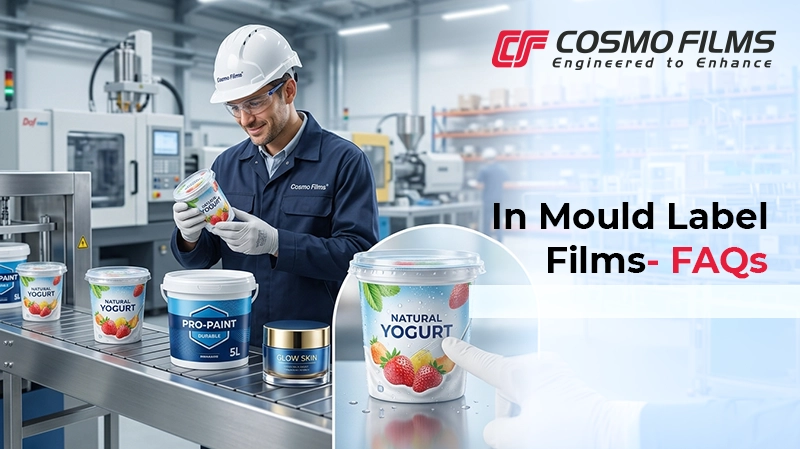
If you are exploring In Mould label (IML) films for your application, you probably have a long list of questions, from material basics and supplier selection to print compatibility and end-use performance. This guide addresses the most common IML film queries to help you make faster, better-informed decisions.
1.
What is an In Mould label (IML)
film?
An IML film is a pre-printed label that is placed inside a mould
and fuses directly with the container during the moulding process, becoming an
integral part of the finished product.
2.
What are the advantages of using
IML films?
The film offers superior aesthetics, excellent label durability,
resistance to moisture and abrasion, and the elimination of an additional
labeling step in the production process.
3.
Which industries commonly use
mould label films?
IML films are widely used in food packaging, dairy and ice cream
tubs, paint and chemical containers, personal care products, and home care
packaging.
4.
What types of containers are best
suited for IML?
Injection moulded PP and PE containers, and thin wall packaging
are the most common applications for IML films.
5.
Does IML improve the shelf appeal
of a product?
Yes, because the label fuses seamlessly with the container
surface, delivering a "no-label" look with vibrant, high-resolution
graphics that significantly enhance shelf appeal.
6.
What print quality can buyers
expect from IML films?
Cosmo Films’ IML films deliver photo-realistic, high-gloss print
quality because the printable surface is engineered for excellent ink adhesion
and color vibrancy.
7.
How does IML film affect the
overall cost of packaging?
While the per-unit film cost may be slightly higher than a basic
adhesive label, the elimination of separate labeling equipment, labor, and
adhesive inventory often results in a lower total cost of ownership.
8.
What role do anti-static
properties play in IML films?
Good anti-static performance ensures the label feeds smoothly into
the mould and sits flat without clinging, wrinkling, or attracting dust.
9.
How durable is the IML label on
the finished container?
The label film is highly resistant to peeling, scratching,
moisture, and chemical exposure throughout the product's shelf life.
10.
What should one look for when
evaluating an IML film?
Key evaluation criteria include film consistency and yield,
anti-static performance, printability across multiple methods, compatibility
with your moulding process, global supply capability, and responsive technical
support.
11.
Are IML films suitable for
food-contact applications?
Yes, many IML films are manufactured to comply with food-contact regulations
but always confirm compliance certifications with the specific supplier.
12.
How does IML compare to direct
printing on containers?
IML delivers far superior graphic quality and design flexibility
compared to direct printing, and it also allows label changes without retooling
the mould itself.
13.
What types of IML films do Cosmo
Films offer?
At Cosmo Films, we offer two types: White In Mould Label (IML)
Films and Transparent In Mould Label (IML) Films.
14.
What are the white IML film grades
available from Cosmo Films?
Cosmo Films offers two white IML grades: HST-2(IML) LB85, a
highly cavitated white opaque BOPP film, and HST-2(IML) LB55, a white
opaque low-density IML film — both co-extruded with one glossy side and one
matte side.
15.
What transparent IML film grades do
Cosmo Films offer?
The transparent IML film grade from Cosmo Films is HST-2(IML)
LBTP, a co-extruded, both-sides-glossy, heat-sealable BOPP film designed
for clear-label applications on PP and PE containers.
16.
What printing methods are
compatible with Cosmo Films' IML films?
All our IML film types are suitable for offset, rotogravure, and
flexography printing, providing converters with full flexibility.
17.
What moulding processes do Cosmo
Films' IML films support?
Our IML films are designed for PP and PE injection moulding
applications, ensuring strong fusion between the label and the container during
the moulding cycle.
18.
Does Cosmo Films offer global
supply for its IML films?
Yes, we have a global footprint with sales offices in India, the
US, Germany, Korea, and Japan, along with manufacturing facilities in India,
enabling us to serve IML film buyers worldwide.
Whether you are a converter, brand owner, or container
manufacturer, choosing the right in mould label film is critical to achieving
the shelf impact, durability, and production efficiency your packaging demands.
To explore Cosmo Films' IML film range in detail or request a sample, reach out
to us at enquiry@cosmofilms.com.
Featured Post
Love to hear from you!
Get in touch.