Love to hear from you!
Get in touch.

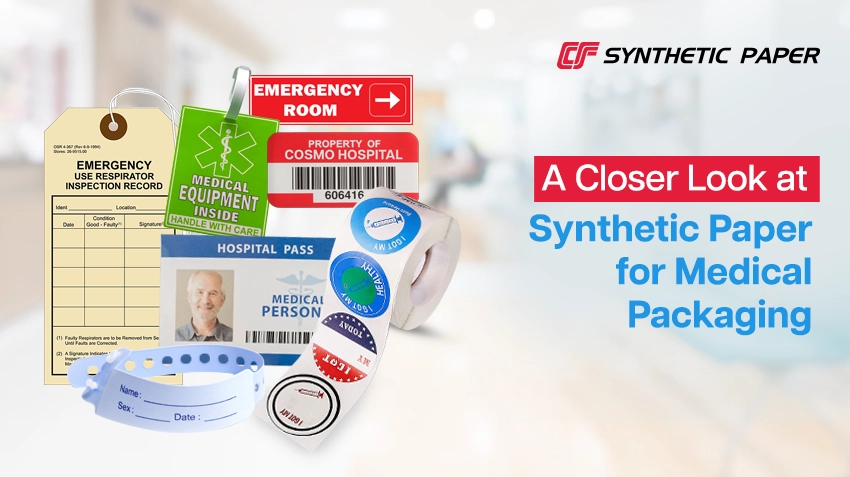
Labels play a crucial role in the healthcare supply chain, from tracking medications and medical devices to monitoring patient information and ensuring compliance with regulations. A smudged or torn label can result in misidentification, dosage errors, or regulatory non-compliance, which can have serious consequences.
This is where synthetic paper steps in. It’s an advanced material that outperforms traditional paper in every aspect relevant to the industry.
Synthetic paper offers:
These properties make it an ideal material for demanding environments like hospitals, laboratories, pharmaceutical manufacturing, and cold storage.
Smart Healthcare Labels
With the increasing digitalization of healthcare, traditional labels are evolving into smart labels, embedded with technology such as barcodes, RFID tags, and QR codes. This enables real-time tracking, patient identification, and inventory management.
High tear resistance paper is the perfect partner for smart labelling technology due to its ability to:
Whether it's a vaccine vial label that must endure freezing temperatures or a wristband that stays intact through days of patient monitoring, synthetic paper provides the reliability that healthcare demands.
Key Applications in Medical & Pharma
Here are some of the major applications where water resistant paper is making a significant difference:
Medication bottles, blister packs, and cartons require labels that remain readable throughout the product lifecycle. Synthetic paper resists abrasion, moisture, and chemical exposure, ensuring the label doesn't fade or degrade.
Synthetic paper can withstand chemical sterilization without losing integrity, which is ideal for surgical tool tagging and labelling.
In vaccine and biological storage, temperatures often drop below -70°C. Traditional paper fails in such conditions, but synthetic paper maintains adhesion, legibility, and durability, ensuring full traceability.
Wristbands made from synthetic paper offer comfort, durability, and security. They resist tearing and water damage, even when exposed to frequent washing or sanitization.
Labelling for test tubes and diagnostic kits must endure various conditions. Synthetic paper ensures that vital identification data remains intact after refrigeration or chemical exposure.
As the medical and pharmaceutical sectors become more technologically driven, reliable, smart, and compliant, labelling materials is becoming more critical. Both side coated paper, with its unmatched durability, compatibility with smart tech, and adaptability to harsh environments, has emerged as the preferred choice.
From improving patient safety to streamlining operations and supporting sustainability goals, synthetic paper labels are not just materials but enablers of modern healthcare excellence.
Whether you're a pharma manufacturer or a hospital administrator, adopting synthetic paper solutions could be the step forward your organization needs to stay ahead in the era of smart, safe, and sustainable healthcare.
Featured Post
Love to hear from you!
Get in touch.