Love to hear from you!
Get in touch.

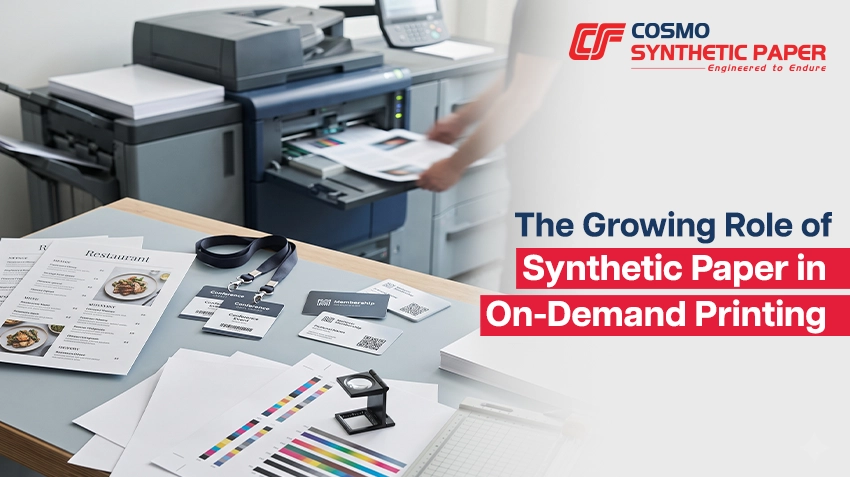
On-demand printing has changed how businesses create printed communication. Instead of ordering large volumes months in advance, brands can now produce exactly what they need when they need it. From personalized marketing collateral and short-run labels to variable-data tags, restaurant menus and retail signage, print jobs are increasingly becoming faster, more targeted and more flexible.
However, this shift also raises expectations for the printing substrate. On-demand printing requires materials that perform consistently across short runs, accept high-quality graphics, remain stable during printing and finishing, and withstand the conditions of their final use. This is where synthetic paper is steadily gaining importance.
Reasons on-demand printing needs better substrates
In many on-demand applications, printed pieces are handled frequently, exposed to moisture, used outdoors or required to last longer than a conventional paper sheet can reliably support.
For example, a restaurant may need to print menus for a seasonal launch at short notice. A retailer may require promotional signage for a weekend campaign. A manufacturer may need variable information tags for products moving through a demanding supply chain. In each case, the printed material needs to look professional while resisting tears, spills, smudging and regular handling.
Synthetic paper helps address these requirements by combining the visual appeal and printability associated with paper with the durability of PP.
Supporting shorter print runs with consistency
One of the biggest advantages of on-demand printing is the ability to produce smaller batches without carrying excess inventory. Businesses can update product information, prices, designs, instructions and campaigns more frequently. This is especially valuable for brands using variable-data printing, where every print may include different names, codes, offers, languages or product details.
For such jobs, consistency matters. A stable substrate can help printers achieve reliable results across different batches, including when jobs are printed, finished and delivered within tight timelines. Synthetic paper’s dimensional stability supports smoother processing through printing, cutting, creasing and finishing operations, helping minimize disruptions caused by material movement or irregularity.
Durability adds value beyond printing
On-demand printing is not only about speed. It is also about producing materials that remain useful throughout their intended lifecycle. A short-run printed item may be required for an event, a retail promotion, a warehouse process or an outdoor campaign. If it tears easily or deteriorates when exposed to water, the business may have to print replacements, adding avoidable time, cost and waste.
Synthetic paper is valued for its tear resistance, moisture resistance and ability to perform in challenging conditions. It does not readily weaken when exposed to water or humidity and resists oils and chemicals, depending on the product grade and end-use requirements.
As a result, on-demand printers can offer customers more durable printed products without necessarily relying on additional lamination for protection. This can simplify the production process for suitable applications while improving the longevity of the finished piece.
Ideal applications for on-demand printing
Synthetic paper can support a wide variety of short-run and variable-print applications. Its suitability depends on the selected grade, printing technology, ink system and required end-use performance, but common opportunities include:
Print compatibility
Synthetic paper grades are developed for multiple printing technologies, enabling printers to select material based on their equipment and performance requirements. Cosmo Synthetic Paper, for instance, is designed for a range of print processes, including conventional and UV offset, water- and UV-based Flexo, thermal transfer, UV inkjet, HP Indigo and HP Latex printing.
That versatility makes it relevant for printers serving varied markets, from labels and tags to commercial print, retail communication and durable promotional material.
As brands move toward more personalized, localized and time-sensitive communication, the demand for responsive printing will continue to grow. The right substrate can make that agility more meaningful by ensuring that short-run printed materials are not only fast to produce but also fit for real-world use.
Frequently Asked Questions
1. Is synthetic paper suitable for digital printing?
A. Yes, synthetic-paper grades are designed for digital and other print technologies, depending on the printer, ink and application.
2. Why is synthetic paper useful for on-demand printing?
A. Synthetic paper supports short-run, variable-data and frequently updated print jobs by providing consistent, durable print performance.
3. Can synthetic paper be used outdoors?
A. Yes, its moisture and weather resistance properties can make it suitable for many outdoor printed applications when the appropriate grade and ink system are used.
4. Does synthetic paper tear like ordinary paper?
A. No, it is designed to be highly tear-resistant or non-tearable compared with conventional paper.
5. Can synthetic paper reduce the need for lamination?
A. For suitable applications, the synthetic paper’s built-in moisture and tear resistance can reduce the need for an additional protective lamination layer.
Featured Post
Love to hear from you!
Get in touch.
