Love to hear from you!
Get in touch.

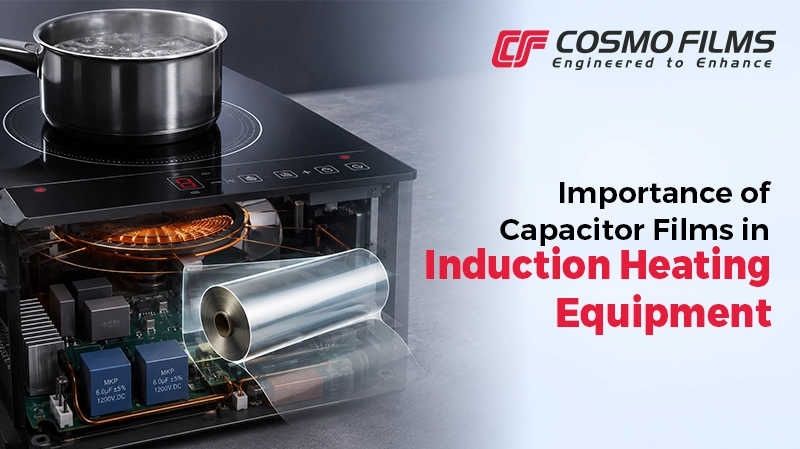
Induction heating equipment runs on precision, and at the heart of
that precision is the capacitor film. Capacitor films store and release
electrical energy in rapid bursts, enabling the machine to generate the
intense, controlled heat needed to harden, melt, or bond metals. Without the
right capacitor film, performance drops, breakdowns increase, and equipment
life shorten dramatically.
Blog Summary
· Why
do induction heating equipment require capacitor films
· Capacitor
Film for induction heating equipment
· Cosmo
Capacitor Films that are ideal for induction heating equipment
· FAQs
Why Do Induction Heating Equipment Require Capacitor Films?
Inside the power circuit of an induction heater, capacitors smooth
out voltage fluctuations, filter electrical noise, and deliver the rapid energy
pulses the machine needs to create a strong electromagnetic field.
The film inside the capacitor is what does the heavy lifting. It
acts as the insulating layer that separates the metal plates, allowing the
capacitor to store energy safely. The quality, thickness, and material of capacitor
polypropylene film directly affect how much energy the capacitor can hold, how fast
it can release it, and how long the entire system lasts before needing
maintenance.
Induction heating equipment is not gentle on its components. The
power circuit operates at high frequencies, which means the capacitor charges
and discharges thousands of times every second.
Here is how the capacitor film must survive, hour after hour,
shift after shift:
|
Voltage
spikes |
Sudden surges in electrical pressure can puncture low-quality
films, causing instant capacitor failure. |
|
High
operating temperatures |
The film must not soften, shrink, or degrade even when
surrounding components run hot for hours on end. |
|
Continuous
charge–discharge cycles |
The film is electrically stressed thousands of times per second.
It must endure this without cracking or thinning. |
What Makes a Good Capacitor Film for Induction Heating?
The ideal capacitor polypropylene film for induction
heating equipment should offer high insulation resistance so it does not leak
current, a wide temperature tolerance to handle sustained heat over long
operating shifts, excellent self-healing ability, meaning if a tiny spot does
break down, the film isolates the damage and keeps working, and consistent
thickness and surface quality so the capacitor performs predictably over its
entire lifespan.
Why Cosmo Films Capacitor Films Are the Right Fit
Our capacitor films are designed specifically for demanding
industrial applications. With over four decades of film manufacturing expertise
and a dedicated team of capacitor industry professionals, we produce metallised
polypropylene films that deliver on all the parameters above.
·
For heavy-duty induction heating equipment, our Al-Zn SLOPE /
RMF Metallised Polypropylene Film is purpose-built.
·
For more advanced induction systems that use power supplies, motor
control circuits, or radiofrequency (RF) circuits, the Al-Zn Segmented
Metallised Polypropylene Film is an excellent match.
Both variants feature excellent self-healing properties,
customisable widths, and special film profiles to meet specific equipment
requirements.
Every capacitor film type undergoes rigorous quality assurance
testing, mechanical, electrical, and visual inspections, ensuring that what
goes into the capacitor meets the highest national and international standards.
Explore our full range of capacitor-grade metallised polypropylene
films, engineered for induction heating and other heavy-duty industrial
applications.
Frequently Asked Questions
Q: Are capacitor films used in all types of induction heaters?
A. Yes.This film plays a key role in performance and reliability.
Q: How often do capacitor films need to be replaced with induction
heating machines?
A. With a high-quality metallised polypropylene film, a good
capacitor film can last many years under normal operating conditions.
Q: What does "self-healing" mean in a capacitor film?
A. If a tiny defect causes a localised electrical breakdown, the
metallised layer around that spot evaporates and isolates the damage, allowing
the capacitor to continue working normally.
Q. Do capacitor films affect energy efficiency?
A. Yes. Lower losses in the capacitor
polypropylene film mean more power goes into heating the workpiece and less
is wasted.
Q: Does Cosmo Films supply capacitor films globally?
A. Yes. Cosmo Films exports to over 100 countries.
Featured Post
Love to hear from you!
Get in touch.