Love to hear from you!
Get in touch.

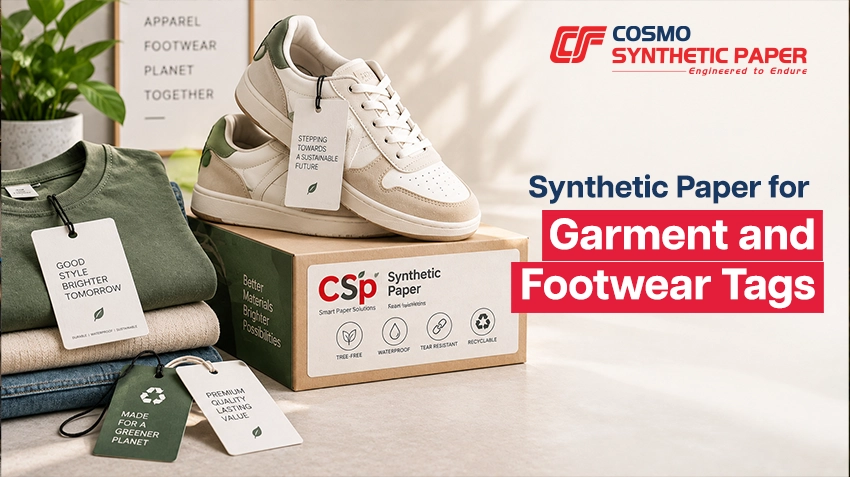
A customer picks up a jacket, checks the price
tag, flips it over to read the care instructions, compares it with another
option, and finally heads to the billing counter. That single tag has already
been handled multiple times before the purchase. If it tears, wrinkles, or
becomes unreadable, it doesn't just affect the tag, but affects the brand's
image. That's why leading garment and footwear brands are moving beyond
conventional paper and choosing synthetic paper for tags that are built to
last.
Why Tag Material Is Important
A product tag is often the first branded
element a customer interacts with. It reflects the quality of the product and
reinforces the brand’s identity. Whether displayed in retail stores,
warehouses, or during transportation, tags must remain clean, readable, and
visually appealing throughout the product’s journey. Even if the product is
flawless, damaged tags can leave a poor first impression.
Synthetic Paper - The best material for tags
and labels
Synthetic paper offers the appearance and
printability of conventional paper while offering significantly better
durability. It’s
·
Tear-resistant
·
Waterproof
·
Oil-resistant
Also, its smooth, premium finish supports
high-quality printing, allowing brands to reproduce vibrant colours, sharp
graphics, fine text, and barcodes with exceptional clarity.
Why Synthetic Paper is Ideal for Garment and
Footwear Tags
·
Garment and footwear tags are
constantly handled by customers, store staff, and logistics teams. Synthetic
paper withstands repeated handling without tearing.
·
Retail environments are not always
controlled. Synthetic paper remains intact and readable even when exposed to
water.
·
Fashion brands rely heavily on visual
appeal. Synthetic paper delivers excellent print results with vibrant colours,
crisp logos, and high-resolution images.
·
Accurate barcode scanning is essential
for inventory management and point-of-sale operations. Synthetic paper
maintains barcode clarity, reducing scanning errors and improving operational
efficiency.
·
Unlike paper that can wrinkle, fray,
or fade quickly, synthetic paper retains its smooth finish.
·
Synthetic paper is compatible with
various printing methods, including offset, flexographic, UV offset, screen,
and digital printing.
Applications of Synthetic Paper Across the
Fashion Industry
Synthetic paper is widely used for:
·
Garment hang tags
·
Footwear tags
·
Apparel brand labels
·
Price tags
·
Promotional tags
·
Care instruction tags
·
Limited-edition collection tags
·
Fashion accessories tags
A product tag may be small, but it carries the
responsibility of communicating essential information, strengthening brand
identity, and shaping customer perception. For garment and footwear brands
looking to combine premium aesthetics with long-lasting performance, Cosmo
Synthetic Paper is an ideal balance of durability, print quality, and
reliability, making every tag as impressive as the product it is attached to.
Frequently Asked Questions
1. Is synthetic paper ideal for garment tags?
A. Yes, its tear resistance, water resistance, and premium print quality make
it ideal for garment tags.
2. Can synthetic paper be used for footwear
tags?
A. Yes, it is widely used for footwear tags because it withstands frequent
handling and moisture.
3. Can barcodes be printed on synthetic paper?
A. Yes, synthetic paper delivers sharp,
scannable barcodes for efficient inventory management.
4. Is synthetic paper resistant to water and
oils?
A. Yes, it resists water, oil, and everyday wear, helping tags remain readable
and attractive.
5. How to request a synthetic paper sample?
A. You can write to us at enquiry@cosmofilms.com to
request a sample.
Featured Post
Love to hear from you!
Get in touch.